Family offices manage trillions in global wealth, with a focus on long-term preservation across generations. Bitcoin is now recognised as a strategic allocation within these portfolios. This move reflects a broader recognition of Bitcoin’s scarcity, resilience and independence from traditional financial systems.
Bitcoin Adoption Gathers Pace
Surveys indicate that nearly 40% of family offices now allocate to Bitcoin, with an average exposure of between 1% and 5% of their portfolios. Allocations are set to rise as younger generations take more influence over investment decisions.
The drivers are clear. Bitcoin’s supply is fixed at 21 million coins, giving it scarcity unmatched by traditional assets. It operates outside political and monetary intervention, making it a safeguard against currency depreciation. And it is increasingly recognised as a modern equivalent of gold, yet more portable, divisible and verifiable.
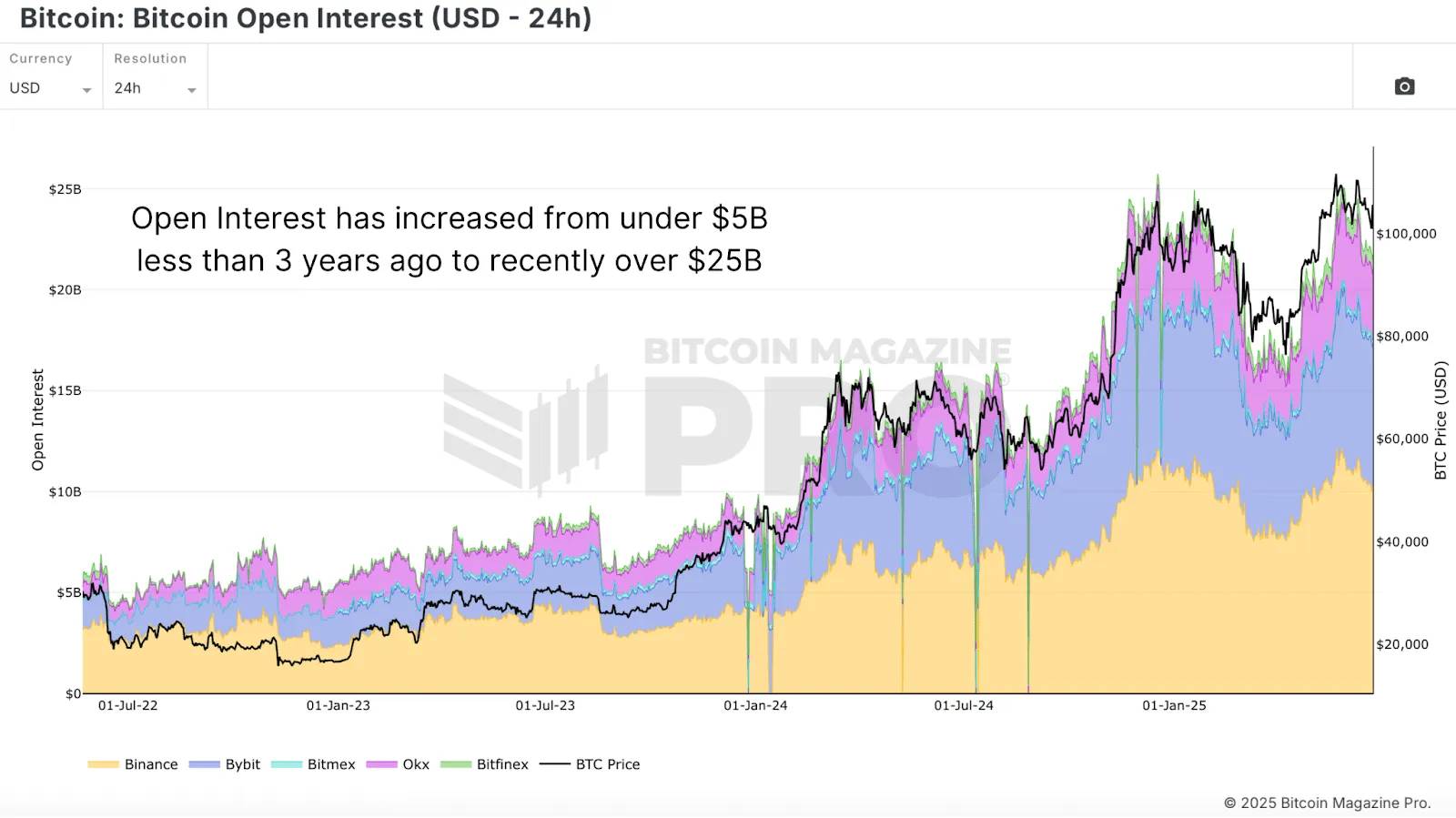 Growth of Bitcoin Open Interest, 2022–2025 (Bitcoin magazine)
This trend is reflected in broader market activity. Open interest in Bitcoin has climbed from under $5 billion less than three years ago to more than $25 billion today (Bitcoin Magazine Pro, 2025). Such growth illustrates how institutional participation and liquidity are expanding, reinforcing Bitcoin’s position as a strategic asset for long-term wealth preservation.
Global Strength in wealth preservation
Family offices worldwide are embracing Bitcoin. In Asia, allocations already reach 5% of portfolios, reflecting a strong belief in its role as a store of value. Europe is following the same path, with many offices seeking protection from.
This international growth confirms Bitcoin’s position as a global asset for wealth preservation.
Strategic Approaches
Early interest centred on simple buying and holding. Today, strategies are becoming more sophisticated. Some family offices invest directly in Bitcoin mining infrastructure to secure access at source. Others engage through institutional products built specifically around Bitcoin. Venture investments in companies building the Bitcoin economy are also on the rise.
What unites these strategies is a clear objective: accumulate and preserve Bitcoin as a long-term element of family wealth. Institutions now treat it as a serious component of asset allocation, aligned with legacy holdings such as land, art, and private equity.
A Generational Reserve
Bitcoin’s design makes it uniquely suited to dynastic wealth. Its fixed supply guarantees scarcity across centuries. Its digital nature ensures portability across borders and generations. Its independence removes exposure to government or central bank decisions. And its transparency allows instant verification of holdings at any time.
For family offices tasked with securing wealth for the long term, Bitcoin is set to serve as a modern reserve asset. Unlike traditional stores of value, it combines durability with flexibility, offering preservation without compromise.
Conclusion: Family offices enter the Bitcoin game
Family offices are no longer observing from the sidelines. They are treating Bitcoin as a central part of long-term wealth strategies, placing it alongside the assets that have historically secured dynastic wealth. As allocations rise, Bitcoin is establishing itself as a trusted reserve for the world’s most enduring fortunes.
Disclaimer
The contents of this analysis are for informational purposes only and do not constitute investment advice. The study is based on the author's opinions and assumptions and may not reflect the actual state of the market or the future outcomes of any investment. The author is not a financial advisor and assumes no responsibility for the information's accuracy, completeness, or suitability.
Bitcoin investments are subject to high risks and volatility. The prices can fluctuate significantly due to factors such as supply and demand, regulatory actions, technological innovations, security breaches, hacking attacks, market sentiment, and global events.
Investors should be aware of these risks and conduct their diligence before making investment decisions.